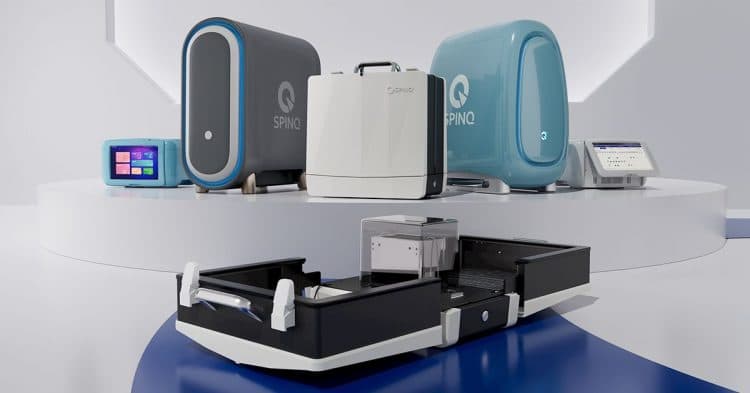
Xiang Jingen is a prominent physicist and the founder and CEO of SpinQ Technology, a pioneering Chinese quantum computing company established in 2018. Under his leadership, SpinQ has emerged as a global frontrunner in developing and industrializing quantum computing technologies, specifically focusing on superconducting and nuclear magnetic resonance (NMR) quantum computers. Xiang's expertise blends rigorous scientific research with commercial acumen, reflecting his academic experiences at Tsinghua University and Harvard University. This article explores ten key aspects of Xiang Jingen's professional journey, SpinQ's technological innovations, business milestones, and impact on the global quantum computing landscape.
Xiang Jingen holds a bachelor's degree and a doctorate in physics from Tsinghua University, one of China's top universities. Following his doctorate, he conducted postdoctoral research at Harvard University, gaining exposure to cutting-edge quantum computing research internationally. His academic foundation in physics and extensive research experience laid the groundwork for his later entrepreneurial ventures, equipping him with deep insights into quantum mechanics and computational theory that inform SpinQ’s technological direction.
In 2018, Xiang leveraged his academic expertise and vision to found SpinQ Technology in Shenzhen, China. The company focuses on the industrialization and commercialization of quantum computing technologies. Under his stewardship, SpinQ integrates superconducting quantum chips, NMR quantum hardware, cloud platforms, and application software to deliver full-stack quantum solutions for scientific research, education, and industry. The founding marked a strategic move aligning China’s growing emphasis on quantum technology innovation with commercial market demands.
SpinQ pursues two main quantum computing technologies: superconducting quantum computers aimed at industrial applications, and nuclear magnetic resonance (NMR) quantum computers designed primarily for education and research. This dual approach allows the company to foster widespread quantum literacy while advancing scalable, programmable quantum systems for complex industrial tasks. Xiang emphasizes superconducting quantum computing for its compatibility with semiconductor manufacturing, scalability, and promising performance.
Under Xiang’s leadership, SpinQ pioneered the world's first programmable desktop NMR quantum computer in 2020, expanding quantum access beyond research labs. In 2023, SpinQ became the first Chinese company to export a superconducting quantum chip overseas, evidencing its growing global footprint. The company also released sophisticated quantum computers such as the three-qubit "SpinQ Triangulum" and ongoing developments toward 100-qubit superconducting systems, reflecting Xiang’s roadmap of doubling qubit counts annually.
SpinQ has secured substantial financial backing, highlighted by nearly 1 billion Chinese Yuan (approximately $145 million USD) raised during a 2026 Series C funding round. These funds significantly bolster the company’s R&D capabilities and facilitate scaling production and commercialization. Xiang’s dual strategy of advancing core quantum technologies while expanding industrial partnerships has attracted prominent investors including government-backed capital, reinforcing SpinQ's status as a leader in China’s quantum computing sector.
Despite Chinese quantum computing technology still trailing the United States by an estimated three years according to Xiang, SpinQ has achieved considerable international impact. The company has delivered products to over 40 countries, including exporting superconducting quantum chips to the Middle East. Xiang actively promotes international technical cooperation to advance global quantum industry chains, reflecting his vision for collaborative innovation that transcends national boundaries.
Xiang Jingen emphasizes building bridges between academia and industry to foster quantum talent and innovation. SpinQ partners with universities such as Tsinghua University, Shaanxi University of Science and Technology, and several international institutions to cultivate future quantum scientists and engineers. These collaborations promote research in quantum algorithms, quantum error correction, and fault-tolerant computing, critical for the maturation of quantum technology.
Xiang envisions quantum computing achieving practical industrial value within the next three to five years, compressing the historical evolution timeline of semiconductor technology. SpinQ targets applications in fields like drug molecule screening, new material research, catalyst design, and financial technology. Xiang compares the complementary nature of quantum and classical computing to airplanes and cars—each suited to different types of problems—highlighting quantum’s niche in solving complex quantum mechanical equations and optimization tasks.
A strategic pillar under Xiang’s leadership is SpinQ’s full-stack control over quantum hardware and software development, from chip design and fabrication to measurement and control systems. SpinQ operates an advanced quantum chip foundry, enabling standardized manufacturing of superconducting quantum chips. This vertical integration enhances product reliability and accelerates innovation cycles, positioning SpinQ at the forefront of industrial quantum computing.
Xiang acknowledges challenges remain, including balancing market expansion with intense R&D demands and advancing quantum error correction and fault-tolerant computing. Nevertheless, SpinQ’s consistent performance doubling and expanding order volume affirm its trajectory toward leadership in industrial-grade quantum computing. Xiang’s roadmap includes deploying scalable quantum systems with hundreds of qubits within upcoming years, striving to realize economic benefits and transform industries worldwide.
Xiang Jingen’s journey from a physicist trained at Tsinghua University and Harvard to the visionary CEO of SpinQ Technology illustrates a compelling fusion of scientific excellence and entrepreneurial dynamism. Under his guidance, SpinQ has transformed from a startup into a global quantum computing powerhouse, pioneering technologies that push the frontier of computing power. With ambitious goals for qubit scalability, industrial applications, and international collaboration, Xiang and SpinQ embody the rapid evolution and immense promise of quantum computing today. As the quantum era unfolds, their progress prompts profound questions about how quantum technologies will reshape science, industry, and society.