Droid Investment Funds represents a groundbreaking paradigm shift in how venture capital identifies and nurtures nascent businesses. Launched in early 2026, it is not merely a traditional investment firm but a platform for the "10 Fund Competition," an experiment that challenges the supremacy of institutional gatekeepers. By pitting nine professional investment funds against a single crowd-sourced fund, the organization seeks to determine whether collective community intelligence can outperform the rigorous, often closed-door, analysis of seasoned venture capitalists. This venture aims to democratize startup discovery, particularly within the dynamic sectors of gaming, XR, esports, and interactive media. Prepare to uncover how this innovative approach is poised to rewrite the rules of modern startup funding and capital allocation.
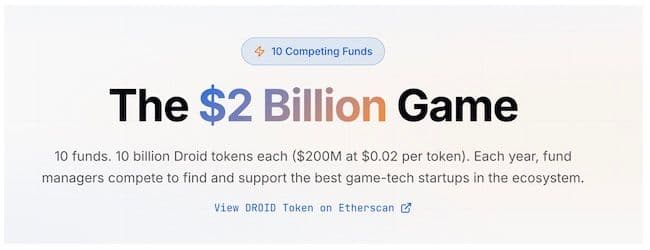
The 10 Fund Competition serves as the centerpiece of the Droid Investment Funds model. It is a live, public contest designed to test a fundamental question: who is better at spotting the future of technology? By directly comparing the performance of nine professionally managed funds against one crowd-sourced fund, the platform creates a real-time scoreboard for startup success. This structure is significant because it moves beyond theory, providing empirical data on whether institutional discipline or the collective conviction of the public leads to better investment outcomes in high-growth technology markets.
Droid Investment Funds specifically focuses its resources on sectors characterized by rapid innovation and disruption: gaming, XR, esports, and interactive media. These industries are notorious for being difficult to navigate due to their fast-paced cycles and unpredictable consumer trends. By narrowing its scope to these areas, the fund ensures that its managers and crowd participants are aligned in their expertise and focus. This specialization is crucial for identifying startups that aren't just trendy, but possess the scalable potential to define the next generation of digital entertainment and interactive commerce experiences.
For decades, venture capital allocation has been confined to private, exclusive circles where founders rely on well-connected gatekeepers. Droid Investment Funds is actively disrupting this status quo by making the entire selection process visible and participatory. By opening the doors to a broader community, they reduce the friction associated with traditional fundraising. This transparency is intended to empower founders, giving them access to market validation that extends beyond a singular firm’s approval. It challenges the conventional wisdom that investment selection must remain a private, opaque, and highly guarded activity.
One of the most intriguing aspects of this platform is the inclusion of a crowd-sourced fund to represent the "wisdom of the crowd." This element tests whether the collective market conviction of many participants can identify winners that professional investors might overlook. This approach recognizes that in the digital age, insights often emerge from communities rather than boardrooms. By giving the public a meaningful, active role in discovery, the platform effectively turns spectators into participants, validating the hypothesis that democratized capital can be just as rigorous and effective as institutional capital.
While the crowd brings intuition, the nine professional funds involved in the competition bring essential industry experience, elite professional networks, and rigorous investment discipline. These professional managers are expected to apply traditional, methodical evaluation techniques to identify companies with long-term viability. By including these professionals, the platform ensures that the competition remains a balanced test rather than a pure popularity contest. This blend of structured professional analysis and spontaneous community insight is designed to provide a comprehensive look at how different investment philosophies translate into real-world business growth.
Transparency is a hallmark of the Droid Investment Funds approach, exemplified by their public scoreboard for startup discovery. By measuring the success of the companies backed by the nine professional funds against those supported by the crowd fund, the platform establishes a persistent, ongoing record of performance. This level of accountability is rare in the venture capital world, where performance data is often siloed. It provides a fascinating, evolving case study that allows observers to witness, in real-time, how different strategies perform against the volatile landscape of early-stage tech startups.
At the helm of this initiative is Andrew Prell, the founder of Convergence 4D and the primary architect behind the 10 Fund Competition framework. Prell has been developing these concepts since as early as 2018, particularly through his writing on blockchain, token-based investment funds, and the virtuous circle of participatory economics. His vision is not just about funding companies, but about creating a new "capital formation engine." By bridging his past research with this new, tangible competition, Prell aims to provide a proof-of-concept for a more open and equitable venture landscape.
For startups, the value proposition of Droid Investment Funds extends far beyond the actual capital investment. Companies entering the competition benefit from immediate visibility, institutional-level market validation, and a compound momentum that only a public competition can provide. By operating within an environment where investor support and market attention accelerate simultaneously, startups gain a massive head start in customer acquisition and brand awareness. This "network effect" is a core feature, as it turns the investment process into a powerful engine for early-stage startup growth.
Droid Investment Funds draws upon intellectual roots that include the evolution of token-based investment funds. These models, which Prell explored in his 2018 framework, were designed to overcome the limitations of traditional capital structures by using decentralized mechanisms to align interests. The current 10 Fund Competition is an evolution of those early theories, testing them against the realities of the current tech market. This history adds a layer of depth to the project, suggesting that the current iteration is the result of years of refinement in how modern digital-first companies should be funded.
Looking ahead, the success of Droid Investment Funds could fundamentally alter how future startups are discovered and funded. If the model proves that either the crowd or a hybrid of professional and crowd strategies can yield superior returns, it may force established VC firms to adopt more open, data-driven, and participatory practices. The long-term goal is to move from a system of "gatekeeping" to one of "discovery-at-scale," where the next generation of winners is identified by the market itself rather than by a select few. The experiment is just beginning.
Droid Investment Funds stands as a bold, experimental endeavor that challenges the traditional insular nature of venture capital. By integrating the rigorous discipline of nine professional funds with the vibrant, collective intelligence of a crowd-sourced fund, the organization has created a transparent, competitive environment for startup growth. Whether this model succeeds in outperforming established norms or simply provides a new way to fuel the next wave of innovation in gaming and XR, it is undeniably shifting the conversation around capital access. As the 10 Fund Competition unfolds, it invites us to reconsider the role of the investor and the power of the market. Can institutional wisdom truly be democratized, or is there an irreplaceable value in the old guard?